Price Transparency
Helping farmers make confident purchasing decisions through transparent pricing data and community-contributed insights.
Farmers were making high-cost purchasing decisions with limited visibility into historical prices, market benchmarks, and what other farmers had actually paid.
Challenge
We created a pricing intelligence experience that helps farmers determine whether a price is fair while building a crowdsourced pricing network that becomes more valuable with every invoice contributed.
Opportunity
Company: Farmers Business Network
My Role: Lead Product Designer
Timeline: 2 Months (2024)
Team: PM, Engineers, Data Scientist & CX
Scope: Research, Data Visualization,
Interaction Design, Prototyping,
& Usability Testing.
Impact at a Glance
3,000–10,000 weekly viewers
~300 weekly chart interactions
853 invoice upload attempts



My Contribution
As Lead Product Designer, I led the project from discovery through delivery, partnering closely with the Product Manager, Data Scientist, Engineers, and Customer Experience team.
Beyond redesigning the visualization itself, I helped shape the broader product strategy by identifying opportunities to expand Price Transparency into a complete experience, including invoice uploads, locked and unlocked states, member and non-member journeys, and supporting admin workflows.
Through research and usability testing, I evaluated multiple visualization approaches before validating a simplified dot-chart model that improved comprehension while supporting a growing set of pricing insights.
The goal was not only to improve pricing visibility, but also to create sustainable mechanisms that encourage community participation and continuously improve the pricing dataset over time.

Where Farmers Struggled
Comparing products required too much effort: Farmers often had to jump between multiple product pages before they could confidently evaluate pricing options.
Price changes lacked meaningful context: Farmers could see prices but struggled to determine whether current pricing was competitive relative to historical trends.
Long-term pricing patterns were hard to understand: Users needed a clearer way to evaluate pricing across seasons and understand how prices changed over time.
Similar products were difficult to evaluate side-by-side: There was no streamlined way to compare competing products and understand which option offered the best value.
Limited pricing data reduced confidence: Sparse invoice data made it difficult to establish reliable market benchmarks and identify pricing trends.

Key User Groups

Farmers: Evaluate whether prices are fair and make purchasing decisions with greater confidence.
Community Builders (CBs): Use pricing insights to advise and support farmers in the field.
Account Executives (AEs): Leverage pricing transparency during customer conversations and purchasing decisions.
Research & Design Exploration

Before redesigning the experience, I explored several approaches for visualizing historical pricing data.
The challenge wasn't simply displaying prices, it was helping farmers quickly determine whether a price was fair while minimizing cognitive effort.
I evaluated three visualization models: a dot chart, bubble chart, and bar chart. Through usability testing with farmers and stakeholders, the dot chart consistently proved easiest to understand, making it the strongest foundation for the redesigned experience.


Scaling the Experience Across Devices
Farmers access FBN across desktop, tablet, and mobile environments, often switching devices throughout the buying journey. After validating the dot-chart approach, I focused on preserving clarity and interaction across screen sizes without sacrificing critical pricing insights.
The experience was refined to maintain readability, support touch interactions, and surface the same decision-making context regardless of device.

Balancing Access & Participation
Price Transparency relied on a continuous stream of pricing data from the community. To encourage participation while preserving the value of the dataset, I designed a contribution model that balanced accessibility with incentives.

Non-Contributors: Preview the value of Price Transparency and submit a non-FBN invoice to unlock pricing insights while contributing to the community dataset.
The experience included non-member onboarding, contribution-based access, partial-access states for inactive members, homepage previews, invoice upload workflows, and supporting admin tools. Together, these experiences helped sustain a crowdsourced pricing network that grows more valuable as farmers contribute fresh market data.

Inactive Members: Continue to access historical pricing trends, but recent pricing intelligence is reserved for farmers who have either contributed invoices or purchased through FBN within the last six months.

Homepage Preview: A simplified example experience displayed across FBN to demonstrate the value of Price Transparency and encourage participation from both members and non-members.
Impact & Outcomes
Price Transparency evolved from a pricing visualization into a community-powered pricing intelligence network.
Impact at a Glance
3,000–10,000 weekly viewers
~300 weekly chart interactions
853 invoice upload attempts
167 farmer-contributed pricing submissions
Key Takeaway
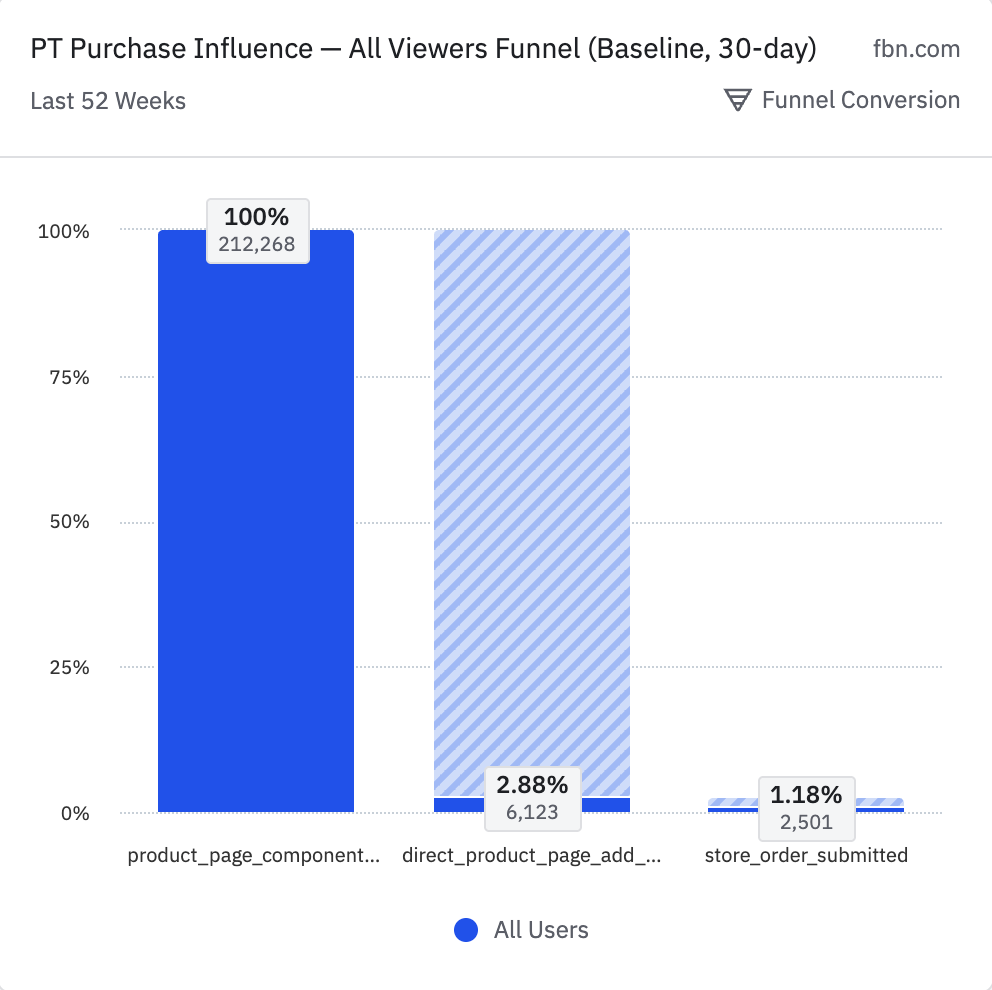
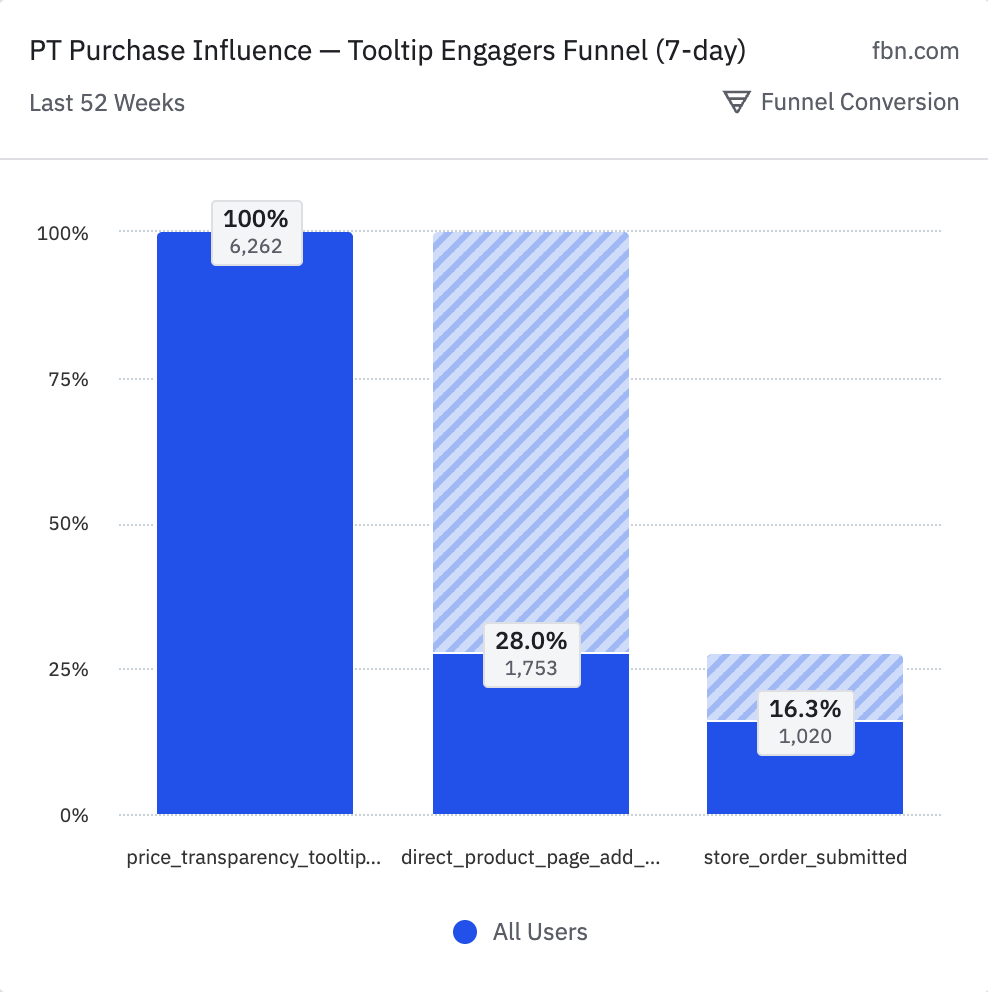
Farmers who actively engaged with pricing insights demonstrated significantly stronger purchase intent and reached purchasing decisions faster than passive viewers.
Behavioral analysis revealed a strong relationship between engagement with pricing insights and purchasing activity. Compared to users who only viewed the feature, farmers who actively interacted with Price Transparency demonstrated:
9.6× higher add-to-cart rates
13.7× higher purchase rates
2.3× faster time-to-cart
While engagement alone does not prove causation, the data suggests a strong relationship between pricing transparency and purchase intent. Farmers who explored pricing insights were more likely to add products to their cart, complete purchases, and move through the purchasing process more quickly.
Beyond improving price visibility, the project helped transform a data scarcity challenge into a crowdsourced pricing network that becomes more valuable as farmers contribute fresh market data.
Purchase Behavior: Passive Viewers vs Active Engagers